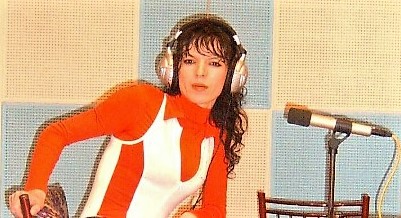
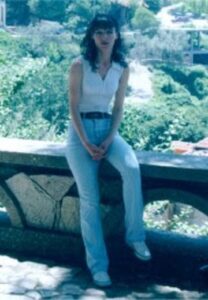
In May 2004, before the books, before journalism became a mission, and before her voice reached wider audiences, Ajetë Sh. Beqiraj gave her first public interview on Radio Tirana, hosted by journalist Valdete Antoni.
This conversation is not an introduction to fame, but an unveiling of origins: childhood, imagination, loss, faith, and the inner necessity to write.
What follows is a rare document of a young woman speaking honestly about creativity, pain, and the silent strength inherited from family and land.
A rare 2004 Radio Tirana interview, reflecting on childhood, creativity, loss, faith, and the origins of a literary voice. Ajetë Sh. Beqiraj’s first public interview (2004), revealing the roots of her writing through memory, pain, faith, and inner resilience.
The path from which this story begins is not merely a village road, but an inner journey. A little girl, fragile in body yet deeply perceptive, walks among stones, voices, and early fears. At times she is forced to move straight ahead; at other times she stumbles and falls. She is frightened by her own shadow, by sounds, by lightning, by the whispering of trees. And yet, she keeps running. Forward. Because something unseen urges her on—something that binds her to the land, to ancient songs, to the memory of those who were born and raised there.
This image, offered by journalist Valdete Antoni, is not a random metaphor, but a sensitive reading of a young author’s inner world—already speaking through two prose books and two poetry collections. These works reveal not only literary talent, but a rare emotional fidelity: a delicate soul marked by painful life events, yet sustained by an enduring inner loyalty that survives the years.
Inviting listeners to accompany her on this journey toward the self, Antoni seeks to make audible the portrait that emerges from the written word.
Ajetë Sh. Beqiraj:
Yes, Valdete — I am inviting you into my life. I come from a small village in Kosovo called Strellc i Poshtëm, a place I love deeply. It is a village with a generous soul, ancient and rich traditions, and above all, a magnificent natural landscape. These are the kinds of surroundings a poet needs when seeking to create — or to reflect the inner self.
I grew up there, shaped by its nature, its beauty, and its sincerity. I come from a noble rural family. We were six children. Our father, unfortunately, was not formally educated — circumstances forced him into that — yet he understood life and read the world more deeply than many scholars ever could.
Valdete Antoni:
Did your father introduce you to poetry?
Ajetë Sh. Beqiraj:
No. It seems that writing came to me more from my mother. Even when she married, she expressed love through verse. Still, throughout my childhood and for as long as my father lived, I was more closely attached to him. I loved him deeply.
The love and support I received from him were privileges none of my siblings had. When he passed away, a part of my soul was torn from me — it felt as though one of my wings had broken. I struggled to rise and continue. Yet life teaches you to love your roots — and to stand again.
Valdete Antoni:
Ajetë, who first gave you this name?
Ajetë Sh. Beqiraj:
It is a strange story, but I will entrust it to you. My parents’ first child was named Ajetë, but my sister died shortly after birth. Later, another brother and another sister were born, but my mother could not bring herself to give them that name.
My aunt, when she had a daughter, gave her the name instead. When I was born, my paternal grandmother said:
“This name belongs to my son’s daughter. I will not give it to my daughter’s child — it will be carried by my son’s.”
And so, the name came to me.
Valdete Antoni:
Did your mother say you resembled your sister?
Ajetë Sh. Beqiraj:
No. She was very beautiful. My mother says she had never seen a more beautiful child — and children whom God takes early carry a beauty of their own.
Valdete Antoni:
How did you see yourself as a child?
Ajetë Sh. Beqiraj:
I always believed I was ugly. That feeling followed me for years, until I became conscious enough to understand the true value of everything around me.
Valdete Antoni:
From what I sense in your writing, it seems that a kind of “magical hand” set this inner movement in motion — helping you see yourself in a truthful mirror.
Ajetë Sh. Beqiraj:
That may well be true. Until a certain age, I was a wild child — climbing walls and trees, doing none of the things girls were expected to do. I hardly read books at all. I never sat down to read the way others did.
Perhaps that “magical hand” touched me differently. At sixteen, quite suddenly, I began to write. “The star that shines…” was the first line I remember. At the time, I thought I had read it somewhere. Later, time proved otherwise — something was inspiring me.
I then began writing my first novel, because the desire for freedom and life in a province are always in conflict — especially when you grow up as the child of parents who are not wealthy.
Valdete Antoni:
And with an extraordinary desire to be yourself — combined with a very distinctive temperament…
Ajetë Sh. Beqiraj:
Yes. And there was also a mentality that forced one to suppress the self. That shaped me deeply. The Ajetë I could not be in real life, I tried to become in my work.
My first novel — written at sixteen and later divided into two parts — is ninety-nine percent pure imagination. Everything I could not have in the real world, I created in my inner one. With time, life gave me many of those things, but back then, I had none of them.
At the same time, the idea of family I later built came from what I had known growing up — a family grounded in honesty, love, closeness, and human understanding. That was my family.
Valdete Antoni:
So you sensed, perhaps even foresaw, what life would later bring — at an age when dreams and reality still lived in separate worlds?
Ajetë Sh. Beqiraj:
I can’t say for certain. But it is true that life later gave me many of the beautiful things I had written about — freedom, being myself, and the fulfillment of desires that once felt unreachable on paper.
Valdete Antoni:
And you wrote your first novel at sixteen?
Ajetë Sh. Beqiraj:
Yes. That is true.
Valdete Antoni:
I would like to share a short excerpt with our listeners.
Night’s curtain was lifting, and dawn slid in, washed by the village dew. Drops of dew lay scattered across the fields like pearls. The song of nightingales opened the crowns of flowers, and the chorus of birds gently awakened the villagers. The sun shone over the pine tops, spilling golden light through the branches onto the village panorama. A single ray slipped through an open window and melted into the glow of a sleeping beauty…
Valdete Antoni:
And the title of this novel?
Ajetë Sh. Beqiraj:
Just like my first poem: “The Star of Fate… Rested in My Hand.”
Valdete Antoni:
Do you remember what first urged you to write it?
Ajetë Sh. Beqiraj:
I don’t know. It was a summer night — the warm twilight air of the village, the pure scent, the wooden terrace. Who knows what inspired me?
Valdete Antoni:
Your poetry carries much pain — pain and a constant sense of waiting. Yet also faith: the belief that something will happen, that you will receive what is meant for you, that God will return what has been destined.
Ajetë Sh. Beqiraj:
Valdete, every success seems to be paid for with a loss. That happened to me as well. I gained on one side and lost on the other — like anyone who knows both roots and rises, falls and beginnings.
It was a painful chapter of my life, tragically sealed by my father’s death. Those poems are the true mirror of my soul and my life.
I want readers to know this — though those who truly understand poetry already do. Every poet clings to something in order to create. Still, I believe that a humane person, one with a pure heart, may struggle in life, but in the end, the victory is theirs. I believe this without doubt, because God loves the good. And if I have nothing else, God has given me a sincere soul — and that is enough.
Ajetë Sh. Beqiraj:
Thank you — truly. Thank you for the respect. My greetings to all listeners, and my deepest regard to my colleagues here at Radio Tirana, whom I must now leave, as I return to Kosovo.
I take with me the very best impressions. Indeed, it feels almost sinful that I walked across Europe before ever setting foot in Tirana. Yet this city has always lived as a folded dream close to my heart. Today, under the most beautiful circumstances, I was finally able to see it.
I met wonderful people here and gained invaluable experiences. I want listeners to know how fortunate they are to have such a devoted staff — people who give everything of themselves so that others may feel heard and cared for. I would have loved to be part of that world.
But Kosovo awaits me. My homeland calls me — and I will return.
Valdete Antoni:
We wish you a safe journey.
Radio Tirana — May 12, 2004
Program Author: Valdete Antoni
Sound Engineer: Vjosa Luto