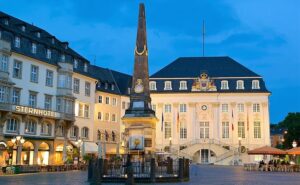
December 2, 2005,Deutsche Welle. The three-day World Assembly for Renewable Energy concluded in Bonn, underscoring the crucial role of renewable energy in alleviating poverty and promoting economic growth. The assembly focused on German energy policy within a renewable energy market of international significance, examining the factors behind its success and its continuity after the parliamentary elections.
Around 300 experts from across the globe gathered in Bonn on the occasion of the three-day World Assembly for Renewable Energy, which concluded its proceedings in the German city. Bonn proved to be an ideal host, not only because it accommodates several United Nations institutions, but also because it is home to more than 150 non-governmental organizations. A number of these organizations are actively engaged in the field of renewable energy, including Eurosolar and the World Wind Energy Association.
Policy Must Enable Renewable Energy
“There is much to discuss — and even more to do. The world needs a new form of energy: renewable energy,” said Bonn Mayor Peter Finger in his welcoming address to the delegates of the World Assembly for Renewable Energy.
Hermann Scheer, President of the European Renewable Energy Council Eurosolar and President of the World Assembly for Renewable Energy, emphasized the decisive role of political action:
“Politics must ensure that the path for renewable energy is opened. One of the greatest misconceptions in debates on renewable energy is the claim that an energy source cannot survive without political support. This has always been the case. The largest privileges granted to opponents of renewable energy were, in fact, hundreds of billions in state support for nuclear power — often without open subsidies — without which no nuclear energy enterprise would have been launched.”
Scheer questioned whether similar support should not be provided for renewable energy, given its long-term security and sustainability in supplying society, as well as its more reasonable initial costs compared to energy sources that will eventually become economically unviable. He pointed out that more than 40 developing countries already spend more on oil imports than they earn from exports.
More Must Be Done to Promote Renewable Energy
Economic development is impossible without access to energy. As long as energy consumers are continuously burdened with high costs, there will be no real escape from economic stagnation. Institutions such as the International Atomic Energy Agency — established to support nuclear development — and the International Energy Agency, founded after the first global oil crisis in 1973, play a role in shaping global energy policy. However, their contribution to promoting renewable energy remains limited.
According to Scheer, both agencies operate as international governmental bodies but often appear aligned with traditional economic interests. “What is missing,” he argues, “is an independent international agency for renewable energy — separate from these institutions — because they have done everything possible to keep renewable energy in the shadows, often by spreading misinformation that hinders its development.”
He called for the establishment of an independent body that would assist governments in developing renewable energy programs and facilitating the transfer of relevant technologies.
German Government Support and Regional Prospects
Scheer, also a member of the German parliament, noted that prospects for founding such an agency had improved, as the new German government had taken initiative. He stressed that such an organization need not exist solely within the framework of the United Nations but could be established alongside it, supported by countries that recognize its necessity.
Renewable energy projects have also begun to expand into Southeastern Europe. According to Scheer, several small-scale initiatives are already underway, with strong development potential despite economic challenges. “Conventional energy sources are becoming increasingly expensive, while renewable energy is becoming more affordable,” he said. “It is produced locally, depends on natural conditions, and does not require imports — a fact that is increasingly evident, even if traditional energy experts tend to ignore it due to perceived threats to their industries.”
Renewable Energy in Kosovo
For a developing country such as Kosovo, renewable energy systems are not only desirable but essential. This view is shared by the Albanian company Research and Development in Kosovo, which on October 21 presented — for the first time in Kosovo — a photovoltaic construction capable of converting solar energy into electricity.
Scheer had long advocated such initiatives, particularly after the war, when not only human losses but also energy infrastructures were destroyed. He argued that instead of restoring outdated systems, Kosovo should invest in modern renewable energy technologies, including wind power, photovoltaics, and bioenergy — the latter playing a crucial role in economic revitalization.
Kosovo possesses significant potential for renewable energy production. Research and Development in Kosovo, in partnership with the German company Yandalux based in Hamburg, is implementing a pilot project for road infrastructure lighting. The system can operate independently of the main grid or feed energy into it.
Ilir Seferi, General Director of Research and Development in Kosovo, considers the project entirely feasible. “This system is environmentally friendly and inexhaustible,” he explains. “Kosovo receives sufficient sunlight to generate a meaningful share of solar energy. With cooperation between the Kosovo government, international lending institutions, and the Kosovo Energy Corporation, such a concept is fully realistic.”
According to Seferi, the government will subsidize renewable energy, the energy corporation will be obligated to purchase it, and banks will provide financing.
Local Expertise and Challenges
Addressing concerns about local expertise, Seferi affirmed that Kosovo has numerous professionals of European standard. “This was demonstrated on October 21, when our experts constructed and installed a model system themselves,” he said. The company’s board includes well-known academics such as Prof. Dr. Rifat Gjota and Prof. Ali Topalli, alongside experienced engineers, and maintains ongoing cooperation and training programs with German partners.
Despite its potential, the project faces challenges. Renewable energy equipment in Kosovo is subject to customs duties of 26.5 percent, compared to just 1 percent in most European countries, despite its ecological benefits and contribution to carbon reduction. However, Seferi expressed confidence, citing assurances of support from the Ministry of Energy.
Ajetë Beqiraj & Shpend Limoni – Deutsche Welle